
From $40 Million to Under $1 Million: What Waiting Cost One Founder
The market gave this founder a window. His investment banking team told him to move. Analysis paralysis kept him frozen. Then the window closed for good.
We were advising a founder who had built a solid business over many years. Good operations, loyal customers, steady revenue. When market conditions shifted in his favor, EBITDA climbed, and the business peaked at a $40 million valuation.
Cash flow was good. The business felt strong. And $40 million became the number. The holy grail.
That was the window. He didn’t take it.
The Paralysis
It wasn’t that the founder didn’t think about a transaction. He thought about it constantly. He ran the numbers. He talked to people. He weighed every angle, every scenario, every “what if.” He wanted to make the perfect decision at the perfect time for the perfect price.
But underneath all that analysis was something simpler: fear. Fear of making the wrong call. Fear of leaving money on the table. Fear of what comes after. So instead of acting, he kept analyzing. And the market kept moving.
He wasn’t ignoring the opportunity. He was studying it to death. And the result was the same as if he’d ignored it entirely.
The Decline
Sales started softening. The broader market shifted, and his numbers reflected it. The $40 million valuation dropped to $30 million.
The founder’s reaction? He’d wait it out. He truly believed he could get back to that $40 million number. He’d seen the business hit it once, so in his mind, that was the real value. The $30 million felt like selling short.
So he held. And the numbers kept dropping.
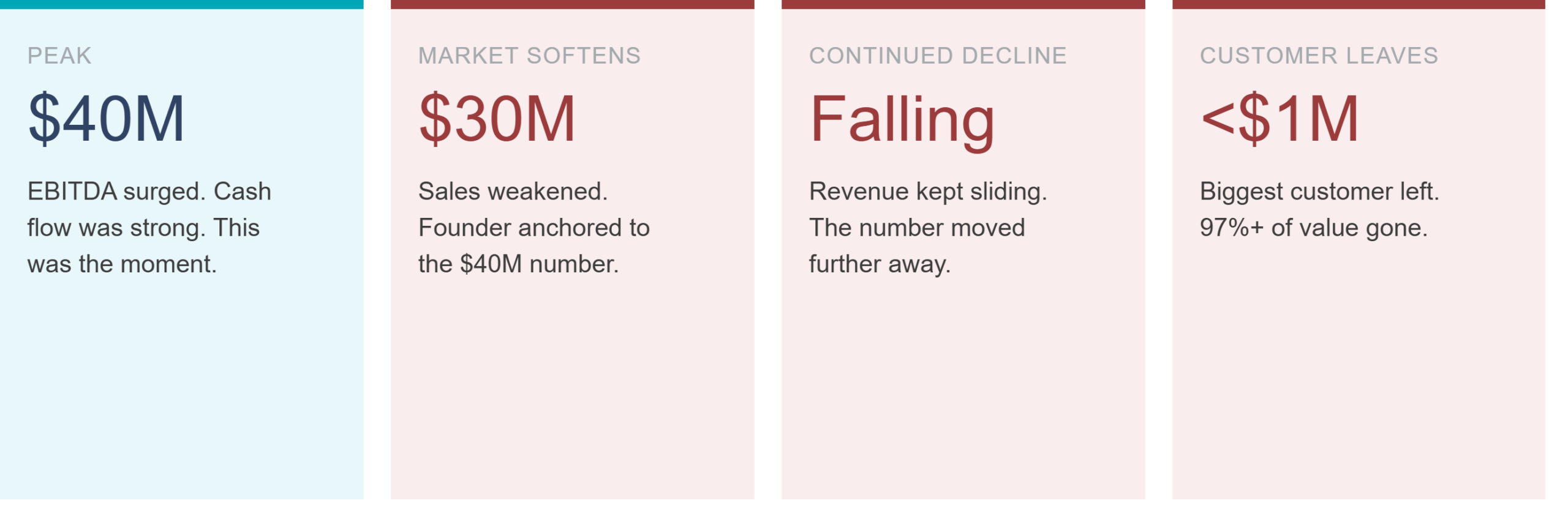
Then the largest customer left. Overnight, the valuation was ripped out from under him. The business that had peaked at $40 million was now worth less than $1 million.
Not because of a bad market. Not because the founder made a catastrophic operational mistake. Because the single biggest risk in the business was the one he couldn’t bring himself to address while he still had time.
What the Banker Was Saying
The founder had an investment banking team. And they were reading the situation clearly.
At $40 million, the banker was telling him: this is the window. The market is giving you a gift. EBITDA is up, conditions are favorable, and investors are active. This is the time to move.
THE RISK NOBODY WANTED TO TALK ABOUT
The banker was also flagging something the founder didn’t want to hear: customer concentration. A disproportionate share of revenue came from a single customer. That’s not just a line item on a risk assessment. It’s the kind of structural vulnerability that can take a business from thriving to worthless in a single phone call. The banker knew it. He said it. The founder heard it but couldn’t act on it.
At $30 million, the conversation got harder. The peak is behind you. $30 million is still a strong outcome. Waiting for $40 million when the trend line is moving the other direction isn’t optimism. It’s anchoring to a number the market has already moved past. And that customer concentration problem? It’s still sitting there. Every quarter you wait, that risk gets bigger.
The founder heard all of it. He understood the logic. But he was paralyzed. The $40 million number had become the only acceptable outcome in his mind, and anything less felt like failure. So he kept waiting for conditions to come back around.
They didn’t.
The Real Cost
This story isn’t about a bad transaction.
It’s about a smart founder who couldn’t make a decision even when his investment banking team presented the right information at the right time. Market windows open and close. EBITDA spikes from favorable conditions don’t last forever. Customer concentration is a ticking risk that gets more dangerous the longer you leave it alone.
That’s exactly why it matters to have a banker in your corner well before you think you need one. Our bankers aren’t here to push every deal to a close when the terms are unfavorable for the seller. That’s not how we operate.
At SDR, our bankers want to make sure you see the full picture clearly enough to make a real decision instead of a default one. We’ll tell you when the window is open. We’ll tell you when conditions favor a move. We’ll flag the risks that are easy to ignore when cash flow is good, and the business feels fine.
And when our bankers say it’s time to go to market, follow that signal.
This founder didn’t. It cost him $39 million.
SDR Ventures tracks market conditions, valuation trends, and deal activity across the lower middle market every day. If you’d like a candid read on where your business sits and what the market is doing in your space, that’s a conversation we’re always happy to have.


