
Tech-Enabled Fulfillment M&A Overview
Tracking deal activity, buyer appetite, and valuation dynamics shaping the tech-enabled fulfillment and third-party logistics M&A market.
Last updated: August 2026
Market Overview
The tech-enabled fulfillment sector is consolidating quickly as brands rethink where and how their orders get shipped. The end of duty-free de minimis treatment in 2025, now held in place under Executive Order 14388, is pushing e-commerce brands to bring fulfillment onshore to avoid new duties and delays. At the same time, Amazon’s May 2026 launch of Amazon Supply Chain Services, opening its freight, fulfillment, and parcel network to any business, signals that scaled, technology-driven fulfillment is no longer a niche capability.
For founders who built differentiated fulfillment platforms, this shift is creating real optionality. Buyers, both strategic and financial, are actively looking for technology-forward operators who can demonstrate a clear edge over traditional 3PLs, and owners weighing a transaction are finding a buyer universe with genuine appetite for what they have built.
Featured Transaction: Boxzooka
SDR Ventures recently served as exclusive sell-side advisor to Boxzooka, a software-driven fulfillment platform built for high-growth, brand-sensitive e-commerce companies, on its majority growth investment from Tower Arch Capital. Boxzooka’s proprietary technology, paired with a scalable footprint carrying significant unused capacity, gave buyers confidence in a long growth runway without near-term capital investment, and strategic and financial buyers competed directly for the asset as a result.

That competitive tension is becoming the norm across tech-enabled fulfillment, where buyers are rewarding operators who can prove out a real technology advantage rather than scale alone.
We're proud to have worked with the Boxzooka team on this transaction and to support a Company with such a strong reputation for technology and customer focus. We believe this partnership with Tower Arch Capital will accelerate software commercialization and create long-term value for Boxzooka's customers, employees, and stakeholders.
Scott Mitchell, Managing Partner at SDR Ventures
Recent M&A Activity and Deal Flow
Private equity has added deals in third-party logistics for three consecutive years, and 2026 has been one of the most active stretches yet for tech-enabled fulfillment specifically. Buyers are moving past scale as the primary criterion and instead consolidating around automation, proprietary technology, and ownership of the customer workflow.
Marquee 2026 transactions illustrate the trend: Thoma Bravo combined WWEX Group with Auctane, Greenbriar Equity Group acquired both AIT Worldwide Logistics and eShipping, Stord acquired Shipwire from CEVA Logistics, and Echo Global Logistics acquired ITS Logistics. Strategic acquirers and PE-backed platforms are competing directly for assets with a strong combination of technology, service, and product, and that competitive tension is showing up in outcomes for well-positioned sellers.

Key Market Drivers
Several forces are shaping seed industry economics heading into the back half of 2026.
-
Onshoring and trade policy pressure. The end of de minimis treatment and Executive Order 14388 are accelerating the shift of fulfillment volume back onto U.S. soil. Brands that relied on low-cost, low-duty cross-border shipping are reevaluating their networks, and domestic fulfillment operators with the right footprint are seeing new demand.
-
Technology over scale. Buyers are prioritizing automation, proprietary platforms, and workflow ownership ahead of pure size. In the age of AI, investor attention is moving from stand-alone software toward operators that combine technology, service, and product, which is redirecting capital toward tech-plus-service fulfillment platforms specifically.
-
Buyer appetite and platform consolidation. Amazon opening its supply chain network to outside businesses, combined with a third straight year of PE piling into 3PL M&A, has widened the buyer universe considerably. Strategic acquirers and PE-backed platforms alike are actively seeking bolt-on and platform acquisitions in this space.
Valuation Context
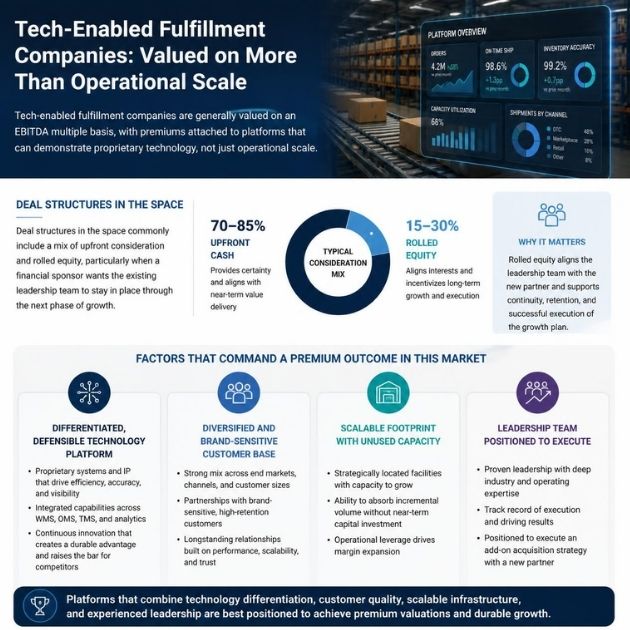
Tech-enabled fulfillment companies are generally valued on an EBITDA multiple basis, with premiums attached to platforms that can demonstrate proprietary technology, not just operational scale. Deal structures in the space commonly include a mix of upfront consideration and rolled equity, particularly when a financial sponsor wants the existing leadership team to stay in place through the next phase of growth.
The factors that command a premium outcome in this market include a differentiated, defensible technology platform, a diversified and brand-sensitive customer base, a scalable footprint with unused capacity to support growth without near-term capital investment, and a leadership team positioned to execute an add-on acquisition strategy alongside a new partner.

SDR Ventures Perspective
Tech-enabled fulfillment has moved from a back-office cost center to a strategic differentiator for the brands it serves. Trade policy shifts, Amazon’s entry into open supply chain services, and a third consecutive year of private equity investment in 3PL have combined to put technology-forward operators squarely in buyers’ sights.
For founders considering a transaction, this environment rewards a well-run competitive process. Buyers are willing to pay a premium for platforms that can show proprietary technology, a scalable footprint, and a clear growth runway, and owners who create genuine competitive tension among strategic and financial buyers are the ones who maximize value and secure the right partner for their next chapter.
Ready to explore your options?
The tech-enabled fulfillment sector is drawing sustained interest from strategic and financial buyers alike. Whether a transaction is on your radar for next year or a few years out, knowing where you stand in this market now puts you in a stronger position when the time comes.
SDR Ventures works with fulfillment and logistics founders across the country to evaluate their options and execute transactions that reflect the full value of what they have built.
Scott Mitchell, Managing Partner at SDR Ventures, leads our tech-enabled fulfillment practice. If you’re weighing your options in this market, we’d welcome a confidential conversation about what a transaction could look like for your business.


