
How to Choose the Right Investment Bank to Sell Your Business
Knowing how to choose an investment bank to sell your business matters more than most owners expect. The firm you hire decides who sees your company, how buyers compete for it, and what you keep when it closes. Most founders sell once. The bankers on the other side of the table do this every week.
The right fit comes down to how a firm is built: who it works for, who staffs your deal, and how it finds your buyer. Pick wrong, and you can pay a fee and still leave money on the table.
Below we break down the three types of M&A advisors owners usually meet, the difference between gross value and net value, and the questions worth asking before you sign an engagement letter.
What Are the Three Types of M&A Advisors?
Most sell-side advisors fall into one of three groups, and they run very different processes. The one you hire decides how hard buyers compete for your business.
A broker’s model runs on volume. Your company goes up on business-for-sale sites next to car washes and franchise resales, a teaser goes to whoever asks, and the broker waits to see what sticks. That can work for a simple business.
For a company with real value, it tells buyers no one is running a competitive process, and they price that in.
It also puts your confidentiality at risk, since a listing can reach your employees, customers, and competitors. We cover this in more detail in Business Broker vs. Investment Banker.
The other two columns charge similar fees, so the difference is who each firm is really working for. An institution-focused bank’s best repeat clients are the private equity firms that buy companies like yours. At a founder-focused bank, the only client in your deal is you.
Gross Value vs. Net Value: What Is Your Advisor Optimizing For?
The headline price in a letter of intent is the number owners remember. It is rarely the number they keep.
Between that price and the wire transfer sit working capital targets, escrows and holdbacks, rollover equity, earnout terms, the asset or stock structure of the sale, and taxes. Earnouts should be upside on top of a solid core price, never a stand-in for it. Two offers with the same headline can leave you with very different results.
Ask every banker you interview how they compare offers, and listen for whether they talk only about price or about what lands in your account after closing.
Net value also covers things a spreadsheet misses: whether your team is protected, what your role looks like after the sale, and whether the buyer fits your plans for your next chapter. An advisor focused on net value tests every offer against those goals. Sometimes that means telling you the right answer is no.
Who Will Actually Work on Your Deal?
This is the question owners most often forget to ask. At some firms, the senior banker who wins your business hands the daily work to a junior team once the engagement letter is signed. At others, one banker carries ten or more deals at the same time.
Your sale will run for months. The people doing the daily work, building the buyer list, managing diligence, and keeping buyers in competitive tension, decide how it goes.
Before you sign, ask to meet the people who will run your process day to day, and ask how many other deals they’re carrying.
Ask how long that team has worked together, too. Turnover in the middle of a process means someone new learning your business while buyers wait.
How Do You Know Which Type of Advisor You Need?
Start with your goals. These signals point toward a founder-focused investment bank:
- Your likely buyers include private equity firms or strategic acquirers, and there’s more than one logical buyer.
- The deal will probably involve structure, such as rollover equity, an earnout, or a quality of earnings review.
- What you keep after closing matters more to you than the headline number.
- You have goals beyond price: your employees, your customers, your legacy, or your own role after the sale.
If two or more of these fit, a listing-style process will likely leave value and options on the table. The earlier you talk to a banker, the more of those options you still have. Many of the things buyers pay for take years to show up in your financials.
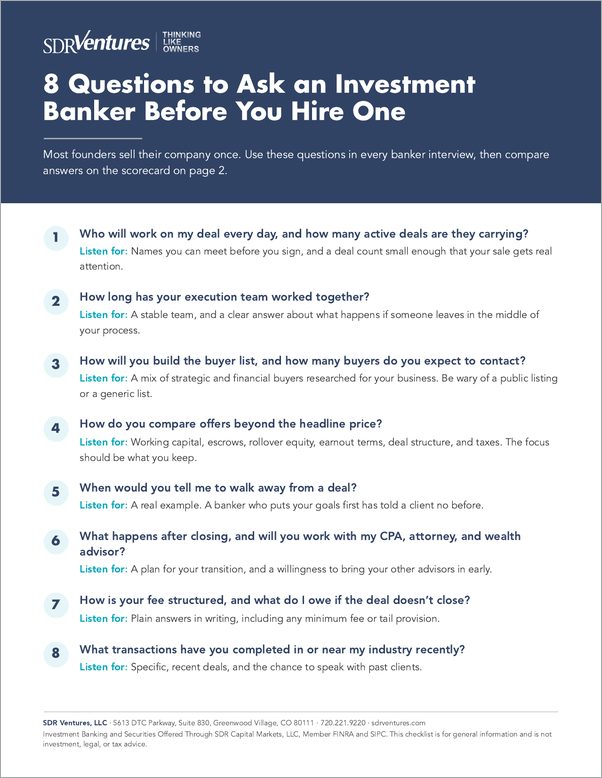
Questions to Ask an Investment Banker Before Hiring
- Who will work on my deal every day, and how many active deals are they carrying?
- How long has your execution team worked together?
- How will you build the buyer list, and how many buyers do you expect to contact?
- How do you compare offers beyond the headline price?
- When would you tell me to walk away from a deal?
- What happens after closing, and will you work with my CPA, attorney, and wealth advisor?
- How is your fee structured, and what do I owe if the deal doesn’t close?
- What transactions have you completed in or near my industry recently?
Pay the closest attention to the answer to question five. A banker who puts your goals first should be able to describe a time they told a client to walk away.
What a Founder-Focused Bank Does Differently
SDR Ventures was built as a founder-focused bank, and it shows in how we run every deal.
- Senior bankers stay on your deal. The bankers you meet in the first conversation are the ones running your process through closing.
- We market your business actively and widely. We build a buyer universe of strategic and financial buyers, contact them directly, and run a competitive process designed to create competitive tension.
- We’ll tell you when to say no. A higher bid with the wrong terms or the wrong buyer is a bad deal, and we’ll say so.
- We keep working after closing. We take on what many banks consider out of scope, including post-closing considerations, alongside your CPA, attorney, and wealth advisor.
- The lower middle market is all we do. It has been our single focus since 2002.
Where to Start
Before you meet with any bank, answer three questions for yourself:
- What does a successful sale look like for you, beyond the price?
- Who do you think your likely buyers are, and why?
- How involved do you want to be after closing?
Then talk to a banker early, ideally a few years before you plan to sell. That gives you time to fix what a buyer would discount and to build the value a buyer will pay for.
If you’re starting to think about a sale, even one that’s years away, reach out to our team. We’ll give you a candid read on your options and what it will take to get the outcome you want.


