
SBA Doubles Loan Limits to $10 Million: What It Means for Small Business Owners
Last updated: July 2026
A significant policy change from the U.S. Small Business Administration is expanding access to capital for small business owners across the country, and it is worth understanding how it works.
What Changed
Effective July 4, 2026, eligible borrowers can now combine SBA 7(a) and 504 loans for a combined total of up to $10 million in SBA-backed financing, doubling the previous cumulative limit of $5 million.
Under the new structure, a qualified borrower who secures a 7(a) loan first may access up to $5 million through the 7(a) program and up to $5 million through the 504 program, stacking them for the full $10 million. Previously, balances from a 7(a) loan reduced what a borrower could access through the 504 program. That offset is now eliminated.
Why It Matters
For small business owners, this change means more purchasing power, whether you are acquiring real estate, buying equipment, or funding operations. The SBA specifically noted that capital-intensive businesses stand to benefit most from the ability to pair long-term fixed-rate financing with working capital.
For business buyers, the expanded limits create meaningful new leverage. A buyer who previously maxed out SBA eligibility on one loan now has a second tranche available, which can be the difference between a deal that closes and one that does not.
What the Programs Cover
The two programs serve different purposes and work best in combination.
The 7(a) loan program is the SBA’s flagship offering. It covers equipment purchases, real estate acquisition, working capital, revolving credit lines, and business expansion.
The 504 loan program provides long-term, fixed-rate financing for major fixed assets, primarily real estate and heavy equipment. These loans are issued through Certified Development Companies (CDCs), nonprofit community partners regulated by the SBA.
Together, they can now cover a much larger share of a transaction.
Where This SBA Rule Has the Most Impact With Small Business Owners
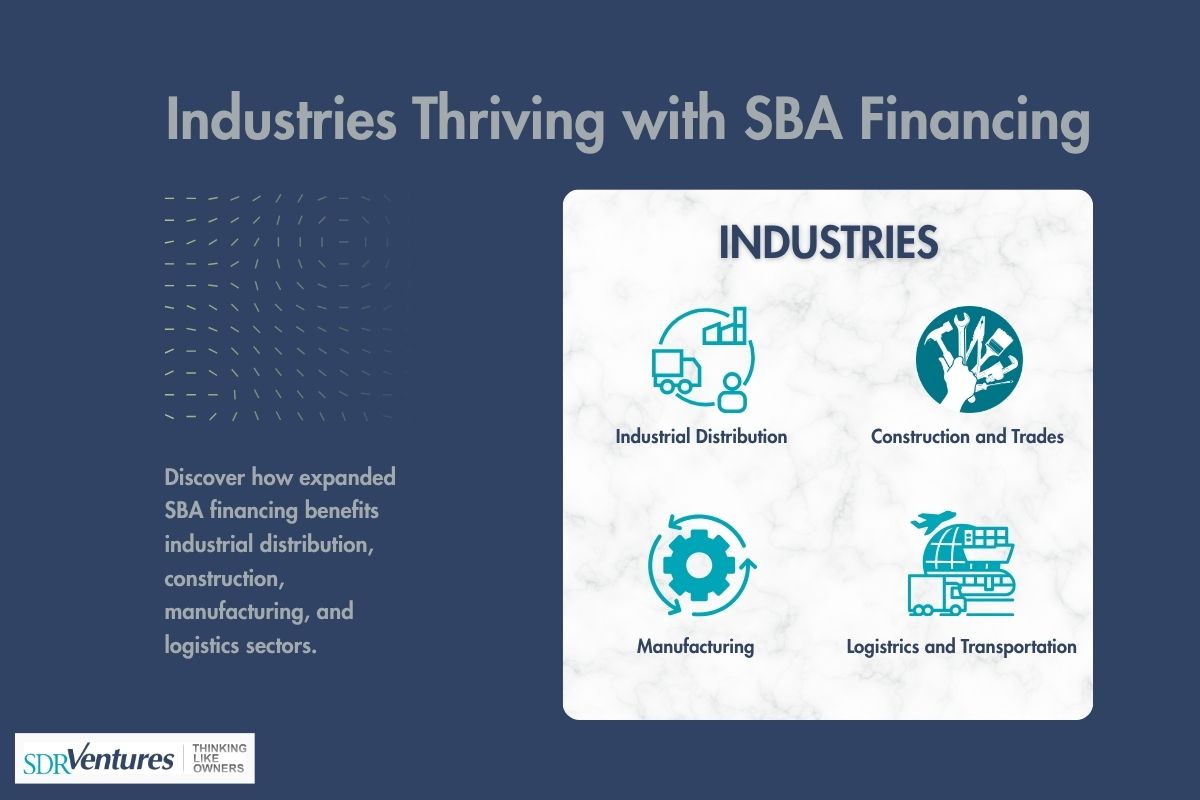
Not all small businesses benefit equally from expanded SBA limits. The industries that tend to carry the most capital-intensive assets, including equipment, facilities, fleet, and inventory, are exactly where the new $10 million ceiling creates real room to move.
- Industrial Distribution
Distributors operate on thin margins with heavy balance sheet requirements. Inventory, warehouse facilities, and material handling equipment all require capital, and acquisitions in this space often involve multiple asset categories at once. The ability to stack a 7(a) loan for working capital on top of a 504 loan for real estate or equipment gives buyers a more complete financing solution and allows sellers to attract a broader, better-capitalized buyer pool. - Construction and Trades
Construction and specialty trade businesses routinely carry significant equipment loads alongside real estate tied to operations. Whether it is a mechanical contractor, an electrical firm, or a site-work company, these businesses often need financing that spans both fixed assets and operational runway. The decoupled loan structure opens the door to that combination in a way the previous rules did not. - Manufacturing
Manufacturers were specifically called out in the SBA’s announcement, and for good reason. Production capacity requires capital investment in equipment, facilities, and workforce. The new rule allows a manufacturer to pursue 504 financing for plant and machinery while still accessing 7(a) working capital, without one eating into the other. For buyers acquiring a manufacturing business, that separation matters. - Logistics and Transportation
Fleet-heavy businesses have always been a natural fit for SBA financing, but the old cumulative cap limited how far that financing could stretch. A logistics company with rolling stock, a terminal facility, and working capital needs could previously find itself capped out before all three were covered. The new structure allows buyers to address each layer of the capital stack more completely.
What This SBA Rule Means in the Context of a Small Business Sale
For business owners considering a sale, buyer financing directly affects deal structure, deal certainty, and your outcome. When buyers have access to more capital, they can offer stronger terms, move faster, and close with confidence. An expanded SBA limit is one more tool that can support a competitive process.
At SDR Ventures, our Small Business Division works with founders and owners in the lower middle market, exactly where SBA financing is most commonly used to fund acquisitions. We understand how these programs interact with deal structure and how to position your business to attract qualified, capital-ready buyers.
If you are thinking about a sale in the next one to three years, this is a good time to understand your options and start the planning process.
How SDR Ventures Brings Investment Banking to Small Business M&A
SDR Ventures’ Small Business Division brings the full investment banking model to companies in the $2 million to $20 million range, a market traditionally underserved by institutional advisory firms.
Where most business owners in this segment are left to navigate a sale on their own or through generalist brokers, SDR’s SMB team runs the same disciplined, process-driven approach used in larger transactions: competitive positioning, a curated buyer universe, and a structured process designed to maximize value.
SBA financing is the most common acquisition tool in this range, and expanded loan access translates directly into more qualified buyers, stronger deal structure, and greater certainty of close. For owners thinking about an exit, the financing environment just got meaningfully better, and so did your options for who is in your corner when it matters most.
Contact us to learn more about how our Small Business Division can help you prepare for a successful exit.
SDR Capital Markets, Inc. is a registered broker-dealer and member of FINRA/SIPC. This content is for informational purposes only and does not constitute financial, legal, or tax advice. SBA loan program eligibility and terms are determined by lenders and the U.S. Small Business Administration. Business owners should consult with a qualified lender, attorney, or financial advisor regarding their specific situation.


