
Why M&A Deals Fall Apart: 10 Reasons and How to Keep Yours on Track
If you want to know why M&A deals fall apart, start here: most of them don’t die in one dramatic moment. They wear down. A number that doesn’t hold up in diligence. A customer who leaves mid-process. A price the owner can’t let go of. A few extra weeks that turn into a few extra months.
For a lower middle market company, a deal that breaks after the letter of intent costs far more than time. Buyers who passed once rarely come back at a better price, your team can tell something was going on, and you’ve spent months running your business with half your attention.
Axial’s 2025 Dead Deal Report studied 75 signed LOIs that never closed. Diligence findings caused nearly half of them: 25.3% from issues outside the financials, such as legal risk, customer concentration, and contract problems, and 21.3% from quality of earnings discrepancies. Below are the ten reasons we see deals go wrong most often, and what you can do about each one before a buyer finds it.
1. Unrealistic value expectations
The most common reason we see a sale stall before it starts is a gap between what the owner expects and what buyers will pay. You hear that a competitor sold for a big multiple and assume your business is worth the same. Sometimes it is. Often that competitor had more recurring revenue, a stronger management team, or twice the scale.
Your value is set by your own numbers and your own risks, and a competitive process is how you find the top of that range. An honest valuation before you go to market costs far less than learning the truth from a low LOI. Here’s more on how to maximize the value of your business.
2. An unclear story
Buyers pay for a future. If you can’t explain plainly where growth will come from, why customers stay, and who runs the business day to day, the buyer fills those gaps with assumptions. Their assumptions are conservative.
The owners who get premium outcomes can explain their advantages, their growth plan, and their team in a few minutes, with numbers behind each point. That story belongs in your marketing materials and in every management meeting after them.
3. Earnings that don’t hold up
Almost every serious buyer will commission a quality of earnings report. If the EBITDA their accountants find is lower than the EBITDA in your marketing materials, the price drops or the buyer walks. In Axial’s data, quality of earnings discrepancies more than doubled as a cause of broken LOIs, from 10.6% in 2023 to 21.3% in 2025.
The usual culprits are add-backs that can’t be documented, revenue recognized in the wrong period, and owner expenses mixed into the business. A sell-side quality of earnings report lets you find those gaps first, on your timeline and your terms.
4. Time
Time is the enemy of every deal. As a process drags, both sides lose energy, and small doubts get room to grow. In 2025, private equity buyers spent an average of 106 days under exclusivity before walking away from deals that broke, according to Axial.
Delays usually come from a seller who wasn’t ready for diligence: documents that take weeks to find, financials that need rework, questions that sit unanswered. The best protection is a data room that’s built before the first buyer call.
5. Material changes during the sale
A sale takes months, and your business doesn’t pause while it happens. You might lose a large customer, a key employee might leave, or a quarter might come in soft. Axial found business underperformance behind 8.0% of broken LOIs in 2025.
Some of this is out of your control. How you handle it isn’t. Tell the buyer quickly and completely, because nothing ends trust faster than a buyer discovering a change you didn’t disclose. And keep running the business: owners who get pulled into the deal full time often see results slip right when buyers are watching most closely.
6. Customer or vendor concentration
If a handful of customers account for a large share of revenue, or one supplier provides something you can’t easily replace, the buyer has to model losing them. In one deal from Axial’s report, a buyer walked because about 40% of the company’s revenue depended on a single government program.
Long relationships help, but buyers can’t price a handshake. Concentration rarely kills a deal on its own. It does when it surfaces late, after the price was set without it. Disclose it early and show what protects that revenue: contracts, tenure, and how deeply you’re embedded in the customer’s operations.
Learn this $39 million lesson from another founder.
7. Reopening terms that were settled
Renegotiation caused 14.7% of broken LOIs in Axial’s 2025 data, usually because the two sides couldn’t agree on revised pricing or structure after diligence. Retrades happen in both directions. Buyers push price down after diligence, and sellers sometimes try to win back points they already conceded.
Every term you reopen costs momentum and invites the other side to reopen one of theirs. The fix is to settle structure in detail at the LOI stage: cash at close, working capital, any rollover equity, and any earnout, which should be upside on top of a price you’re already happy with.
8. Weak internal controls
Diligence often turns up small things. Receivables nobody chases. Inventory counts that don’t match the books. A late regulatory filing. Contracts that were never signed. On their own, each is minor. Together they tell a buyer the business isn’t tightly run, and they start to wonder what else they haven’t found.
Clean up the back office a year before you sell, not in the middle of diligence. These steps to increase business value before selling are a good place to start.
9. Reaching for the last dollar
It’s natural to want every dollar after decades of building your life’s work. The trouble starts when an owner fixes on one number and turns down a strong offer because the next buyer might pay a little more. We’ve seen multi-million dollar deals lost over gaps that were small next to the total.
Look at the whole offer: cash at close, tax treatment, your role after the sale, and what happens to your people.
If an offer meets your goals for your next chapter, a small gap on headline price is rarely worth losing the deal.
Axial found 13.3% of broken LOIs ended because the seller backed out, which is why it pays to decide what you want before you go to market, not during it.
10. The wrong advisors
Most owners sell one company in their lifetime. Most buyers do deals for a living. That gap shows up in pricing, in structure, and in how problems get handled when they come up.
A strong deal team usually includes an investment banker or M&A advisor to run the process, a transaction attorney (often not your regular corporate attorney), a CPA who understands deal structure and tax, and a wealth advisor who plans for what you do with the proceeds.
An experienced team won’t prevent every problem, but it will spot most of them while they can still be fixed.
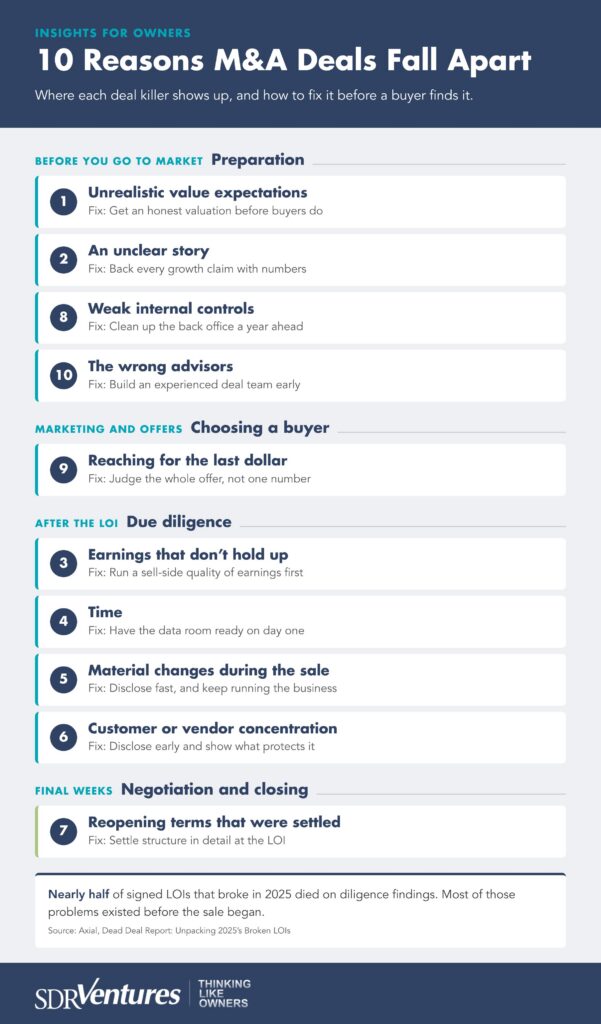
How to keep your deal on track
Most of these problems exist long before a buyer arrives, which means most of them can be fixed with time. Four questions will tell you where you stand:
- Could you defend your EBITDA, add-back by add-back, to a buyer’s accountant?
- What share of your revenue comes from your top three customers?
- If you were gone for a month, who would run the business?
- Do you know the price and structure you’d accept, and why?
If any of those gave you pause, you’re in good company, and you likely have time to fix it. That’s the work we do. Since 2002, SDR’s bankers have helped founders find these issues before buyers do, then run a competitive process built to get to the closing table. We’ve closed 88% of the deals we’ve taken to market.
The best time to talk to us is before a buyer is asking the questions. Reach out to our team for a candid, confidential read on where your business stands and what it would take to sell it on your terms.


