Wealth Management & RIA M&A: Market Overview and Advisory Insights
Tracking deal activity, valuation benchmarks, and buyer dynamics shaping the wealth management and RIA M&A market.
Last updated: July 2026
Market Overview
The registered investment advisory (RIA) market has experienced sustained consolidation over the past decade, driven by succession pressure, rising operational complexity, and the growing appeal of scale.
Independent firms that once viewed M&A as a last resort are increasingly pursuing strategic partnerships as a path to expanded capabilities, access to capital, and long-term continuity for clients and staff.
Consolidation is no longer concentrated among the largest firms. Capital that once flowed primarily to billion-dollar RIAs is now moving into smaller and mid-sized practices, as acquirers and consolidators recognize the value of well-run, relationship-driven firms at every AUM tier. For founders considering their options, the current environment offers a meaningful range of partnership structures and buyer types.
Recent M&A Activity
Featured Transaction: SDR Ventures advised RIA managing nearly $1 billion in assets
The firm served a select group of high-net-worth and ultra-high-net-worth households across Colorado and Arizona, offering investment management, financial planning, and multi-generational wealth strategies built around a highly personalized service model.
Through the partnership, the advisory team gained access to an expanded suite of client services including tax strategy and preparation, concentrated risk management, trust and estate review, and family governance, enhancing its ability to serve clients’ most complex financial needs while preserving the continuity and culture that defined the firm since its founding.
SDR Ventures served as exclusive sell-side advisor throughout the transaction process.
It was a privilege to advise the Elk River team on this important milestone. Throughout the process, our focus was on finding a partner that aligned with Elk River's client-first culture, long-term growth objectives, and commitment to its employees. AlphaCore distinguished itself as the clear strategic fit.
Ben Luchow, Managing Director, SDR Ventures
Additional Market Activity
This transaction is representative of what we are seeing across the RIA landscape. Founder-led firms with strong client relationships and a differentiated service model are attracting serious buyer interest, and the range of partnership structures available today gives sellers more flexibility than at any point in recent memory. Consolidators, private equity-backed platforms, and strategic acquirers are all actively competing for quality practices, and that competitive dynamic is translating into favorable outcomes for sellers who run a disciplined process.
Deal volume in the wealth management and RIA sector has remained elevated, with activity accelerating across firm size categories.
Small RIAs managing between $100 million and $500 million in assets represented 50% of transactions in 2022 and 2023 but accounted for just 32% of deals in the first quarter of 2026, reflecting a meaningful shift toward mid-sized and larger firms.
Minority interest transactions, which historically concentrated on larger platforms, are now flowing into sub-$2 billion RIAs at a pace that already exceeds full-year 2024 totals through the first quarter of 2026 alone.
Integrators, acquirers that centralize infrastructure, compliance, and back-office functions, now represent approximately 79% of consolidator transactions, up from roughly 50% in the early 2010s. This shift reflects a growing seller preference for partners that can absorb operational complexity while allowing advisory teams to remain client-focused.
Key Value Drivers
Several structural forces are shaping deal activity in the wealth management and RIA market:
Succession pressure remains a primary catalyst. Only 22% of RIA principals report that the next generation within their firm can afford to buy out founders, down from 38% four years ago. Rising valuations have effectively priced out many internal succession candidates, making external partnerships a more viable and often more attractive path.
Scale and service expansion are motivating sellers beyond succession. Founders are increasingly seeking partners that can bring capabilities their firms cannot build independently, including tax strategy, estate planning, risk management, and family governance services. Partnership with a larger platform allows advisory teams to deepen client relationships without proportionally increasing overhead.
Buyer appetite remains strong. Consolidators, private equity-backed platforms, and strategic acquirers continue to compete for quality RIA practices, particularly those with diversified client bases, strong organic growth, and younger client demographics. For purposes of RIA valuation, organic growth refers specifically to AUM additions from new or existing clients, excluding market-driven appreciation, as it reflects the firm’s true business development momentum and client retention strength.
Valuation Context
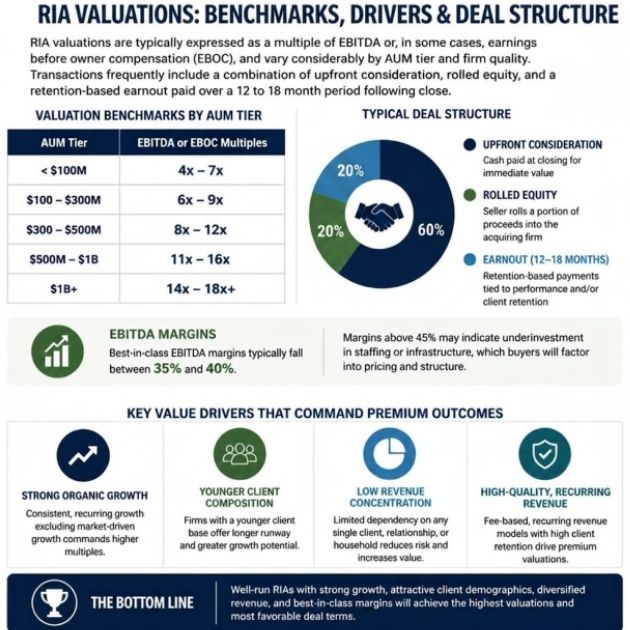
RIA valuations are typically expressed as a multiple of EBITDA or, in some cases, earnings before owner compensation (EBOC), and vary considerably by AUM tier and firm quality. Transactions frequently include a combination of upfront consideration, rolled equity, and a retention-based earnout paid over a 12 to 18 month period following close.
General valuation benchmarks by AUM tier:
AUM Tier
EBITDA or EBOC Multiples
< $100M
4x – 7x
$100 – $300M
6x – 9x
$300 – $500M
8x – 12x
$500M – $1B
11x – 16x
$1B+
14x – 18x+
Best-in-class EBITDA margins typically fall between 35% and 40%. Margins above 45% may indicate underinvestment in staffing or infrastructure, which buyers will factor into pricing and structure.
Key value drivers that command premium outcomes include organic growth rate, excluding market-driven growth, younger client composition, and low revenue concentration, meaning limited dependency on any single client relationship or household.
SDR Ventures Perspective
The wealth management and RIA sector is in the middle of a significant consolidation cycle, and the pace shows no signs of slowing. Founder-led firms at every AUM tier are evaluating their options as succession becomes more complex, operational demands increase, and the strategic and financial benefits of partnership become harder to ignore.
What has changed most notably in recent years is the range of buyers actively competing for quality practices. Integrators, strategic acquirers, and private equity-backed platforms are all pursuing well-run RIAs, and that competition is creating favorable conditions for sellers who approach the process with the right preparation and representation.
Firms that have invested in their teams, maintained diversified client relationships, and built a clear cultural identity are commanding strong outcomes.
Ben Luchow, Director at SDR Ventures, leads our wealth management and RIA advisory practice and works directly with founders and principals navigating this decision.
Ready to explore your options?
Considering a partnership or sale of your RIA?
Whether a firm is actively exploring a transaction or simply beginning to think through its options, the earlier that conversation starts, the better positioned a founder will be to achieve an outcome that reflects the full value of what they have built.
SDR Ventures works with wealth management founders and principals across the country to evaluate their options and execute transactions that reflect the full value of what they have built.
Contact our team to start a confidential conversation.
To provide the best experiences, we use technologies like cookies to store and/or access device information. Consenting to these technologies will allow us to process data such as browsing behavior or unique IDs on this site. Not consenting or withdrawing consent, may adversely affect certain features and functions.
Functional
Always active
The technical storage or access is strictly necessary for the legitimate purpose of enabling the use of a specific service explicitly requested by the subscriber or user, or for the sole purpose of carrying out the transmission of a communication over an electronic communications network.
Preferences
The technical storage or access is necessary for the legitimate purpose of storing preferences that are not requested by the subscriber or user.
Statistics
The technical storage or access that is used exclusively for statistical purposes.The technical storage or access that is used exclusively for anonymous statistical purposes. Without a subpoena, voluntary compliance on the part of your Internet Service Provider, or additional records from a third party, information stored or retrieved for this purpose alone cannot usually be used to identify you.
Marketing
The technical storage or access is required to create user profiles to send advertising, or to track the user on a website or across several websites for similar marketing purposes.